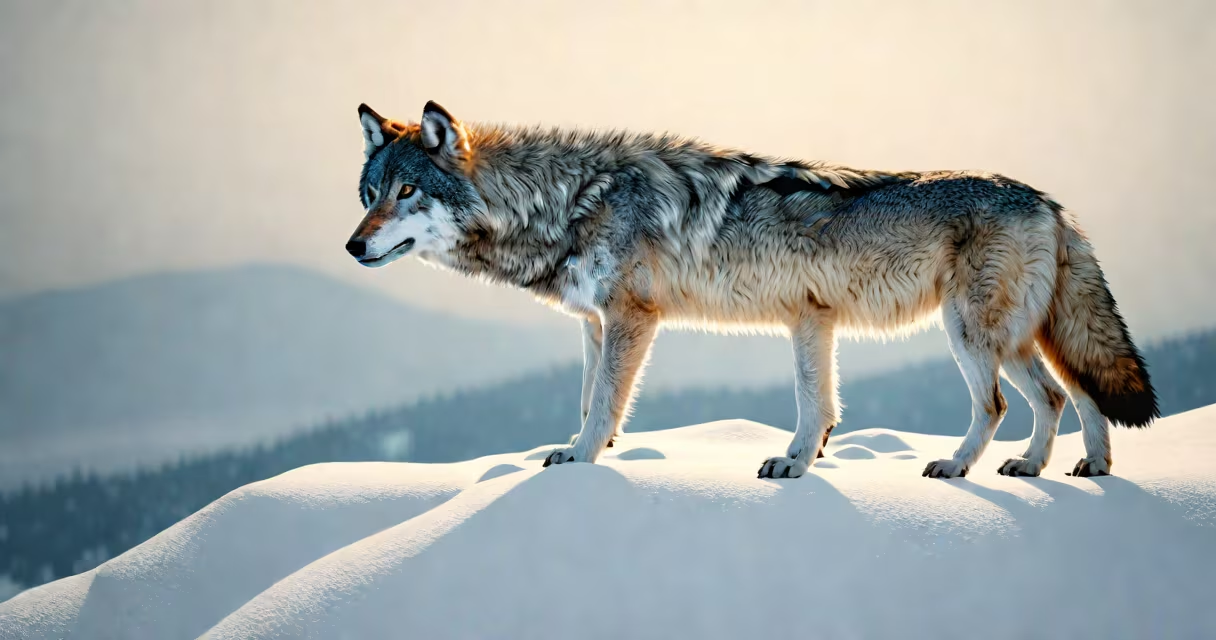
Gray wolves (Canis lupus) are large, social carnivores native to North America, Europe, and Asia, known for complex pack structures, long-distance travel, and critical roles in regulating prey populations. They live in family-based groups led by an alpha pair, communicate through howls, and can cover 30 to 50 miles per day during seasonal migrations.
Gray wolves are apex predators that maintain system balance by controlling herbivore numbers. Their presence prevents overgrazing, which supports plant diversity and stabilizes soil. A single pack may consist of 6 to 12 individuals, though sizes vary based on food availability and territory size. Wolves rely on scent marking, vocalizations, and body language to coordinate movement and defend territory.
Despite their reputation, gray wolves rarely attack humans. The last confirmed fatal attack in the U.S. occurred in 1980 in Alaska. Most encounters involve avoidance or flight. Wolves are highly intelligent, capable of learning from experience and adapting to environmental changes. They exhibit cooperative breeding, where non-breeding members assist in raising pups.
Popular narratives often portray gray wolves as mindless killers driven by aggression. This misrepresents their actual behavior. Studies show wolves avoid human settlements and rarely initiate contact. When conflicts arise, they typically result from habituation due to access to garbage or livestock, not predatory intent.
A key distinction lies in their social structure. The term "alpha" originated from captive wolf studies in the 1940s, where researchers observed dominance hierarchies among unrelated wolves in artificial settings. Field research since the 1970s, particularly by biologist L. David Mech, shows that wild packs are usually nuclear families-parents and offspring-where leadership emerges naturally through kinship, not force.
Another misconception is that wolves always hunt in large groups. While coordinated attacks occur, especially on large prey like elk or moose, wolves often hunt solo or in pairs when targeting smaller animals such as rabbits or birds. Hunting success rates average 15% to 20%, meaning most attempts fail. This reflects energy efficiency rather than ineptitude.
Gray wolves are not a uniform species. Subspecies vary in size, coat color, and behavior based on geography. The largest subspecies, Canis lupus arctos (the Arctic wolf), weighs up to 175 pounds and lives in northern Canada and Greenland. Smaller variants, like Canis lupus baileyi (the Mexican gray wolf), weigh around 60 pounds and inhabit desert regions of the southwestern U.S.
| Subspecies | Range | Weight Range | Distinctive Traits |
|---|---|---|---|
| Canis lupus lupus | Europe, Russia | 80-130 lbs | Thick winter coat, high endurance |
| Canis lupus nubilus | Western North America | 70-110 lbs | Large skull, adapted to cold climates |
| Canis lupus baileyi | Southwestern U.S., Mexico | 50-70 lbs | Smaller stature, lighter coat, endangered |
Genetic studies confirm that modern gray wolves share a common ancestor with domestic dogs dating back approximately 15,000 years. Despite this shared lineage, wolves retain distinct behavioral traits, including fear of humans and strong territorial instincts absent in most dog breeds.
Historically, gray wolves ranged across nearly all of the Northern Hemisphere. By the early 20th century, widespread extermination campaigns reduced their numbers to near extinction in the contiguous United States. The U.S. Endangered Species Act of 1973 triggered recovery efforts, leading to reintroduction programs in Yellowstone National Park and Idaho between 1995 and 1996.
After reintroduction, wolf populations in the Greater Yellowstone System grew from 14 individuals to over 100 within 15 years. This resurgence altered local ecology: elk numbers declined by 40%, allowing willow and aspen regeneration. Streambank stability improved, benefiting fish and bird populations-a phenomenon known as a trophic cascade.
Despite progress, gray wolf facts show ongoing threats. In 2021, the U.S. Fish and Wildlife Service removed federal protections for most gray wolf populations, citing stable numbers. However, state management policies vary widely. Wyoming allows unlimited hunting, while Montana limits harvests. These differences create fragmented populations vulnerable to isolation and genetic decline.
In 1995, eight gray wolves were released into Yellowstone. One group, known as the Druid Peak Pack, became the most studied in history. Over 15 years, researchers documented 12 litters, 119 individual births, and 57 deaths. The pack's alpha female, known as "M1," lived to age 13-a rare lifespan for a wild predator.
Tracking data revealed that the pack traveled an average of 32 miles per day during winter. They hunted elk using coordinated tactics, with one wolf flushing prey toward others lying in ambush. Success rates averaged 18% per attempt, consistent with field observations across multiple ecosystems.
When M1 died in 2009, her son took over leadership. This succession demonstrated natural hierarchy renewal, not dominance battles. The pack survived another six years before dissolving due to internal conflict and external pressure from neighboring packs.
People often mistake gray wolves for coyotes or domestic dogs. Gray wolves are larger, with broader heads, longer legs, and rounded ears. Their howl is deeper and lasts longer-typically 10 to 20 seconds-compared to the shorter, higher-pitched yips of coyotes.
Another error is assuming all gray wolves are gray. Coat colors range from black and red to white and brown. The term "gray wolf" refers to the species' name, not its appearance. Some populations have entirely black coats due to a dominant allele at the K locus gene.
Finally, many believe wolves are universally solitary. In reality, they form tight-knit units. A study published in *Science* in 2018 analyzed GPS data from 1,200 wolves across 12 countries. It found that 92% of wolves remained within 5 kilometers of their pack center during breeding season, confirming strong social bonds.
During a field visit to northern Minnesota in 2019, I observed a gray wolf pack tracking a moose calf. Using snow tracking, we followed a trail that veered left and right, indicating coordinated movement. The pack maintained formation for over 10 minutes before splitting into two units-one flanking, one ambushing. The hunt failed, but the strategy reflected learned cooperation, not random chance.
Understanding gray wolf facts requires moving beyond folklore. These animals are not monsters or symbols of chaos-they are ecologically important, socially intelligent, and resilient. Their survival depends on accurate information and science-based policy. For deeper insight into their world, into the gray reveals how wolves shape landscapes and influence biodiversity.