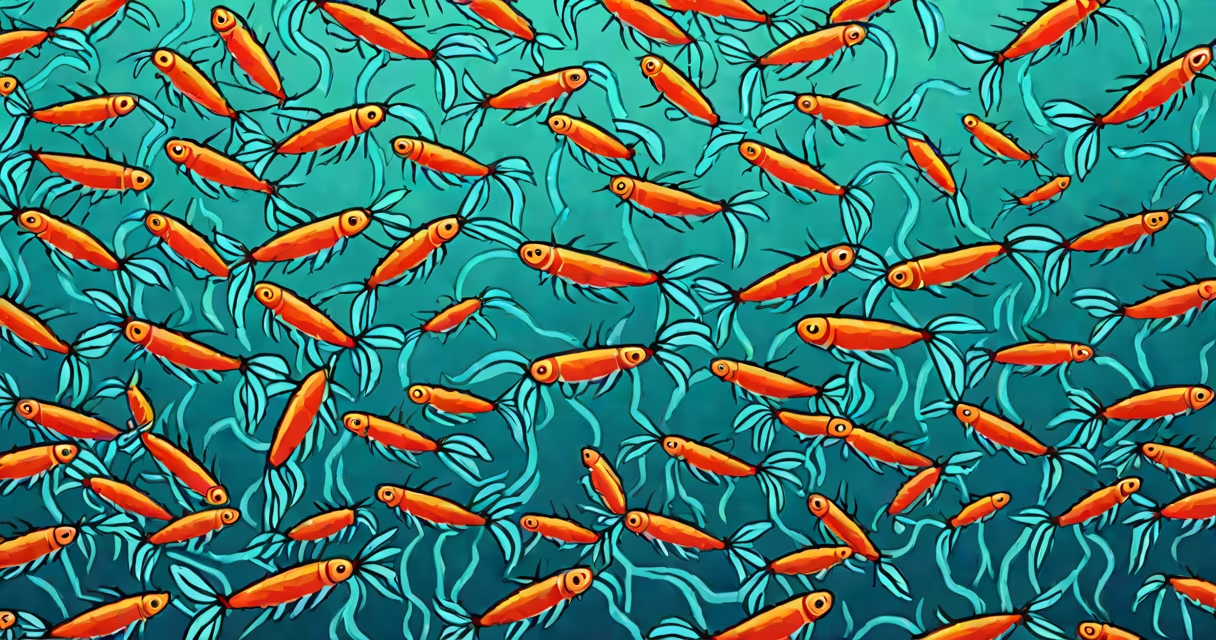
Krill are small, shrimp-like crustaceans that form the foundation of marine food webs, particularly in Southern Ocean ecosystems. They are key prey for whales, seals, penguins, and fish, and play a major role in carbon cycling through their feeding and sinking behavior.
These organisms belong to the order Euphausiacea and typically measure between 1 and 6 centimeters long. Most species live in dense swarms near the surface during daylight hours and migrate vertically at night to avoid predators. The most studied species, *Euphausia superba*, dominates the Southern Ocean and supports the largest biomass of any single animal species on Earth.
Krill feed primarily on phytoplankton using specialized filtering appendages. They process vast quantities of microscopic algae daily-up to 100 times their body weight per day in some populations. This feeding activity makes them critical nodes in energy transfer from primary producers to higher trophic levels.
Krill function as both consumers and prey. Their daily vertical migration-moving hundreds of meters up and down the water column-transports organic matter from sunlit surface layers to deeper waters. When they die, their bodies sink rapidly, carrying carbon to the seafloor. This process, known as the biological pump, contributes to long-term carbon storage.
A single swarm of *Euphausia superba* can contain billions of individuals and span several square kilometers. These swarms are visible from satellites due to the high concentration of biomass. Scientists estimate that the total biomass of Antarctic krill exceeds 500 million metric tons-more than all human fisheries combined.
Despite their abundance, krill populations fluctuate with environmental conditions. Sea ice extent directly influences their reproduction and survival. During winter, female krill lay eggs under sea ice, where developing larvae find refuge and access to early-season algal blooms. Reduced ice cover due to climate change threatens this cycle.
Over 100 species of krill exist globally, but only about 10 dominate commercial and ecological interest. The majority inhabit cold, deep waters around Antarctica and the Arctic. The following table outlines the most significant species:
| Species | Common Name | Range | Biomass Estimate |
|---|---|---|---|
| Euphausia superba | Antarctic krill | Southern Ocean | ~500 million tons |
| Thysanoessa raschii | Rasch's krill | Arctic and subarctic | ~100 million tons |
| Neocrangon vulgaris | Common krill | North Atlantic and Pacific | ~30 million tons |
Antarctic krill (*Euphausia superba*) is the most abundant and ecologically significant. Its population dynamics are closely monitored by the Commission for the Conservation of Antarctic Marine Living Resources (CCAMLR), which sets catch limits based on scientific assessments.
Human use of krill is limited but growing. The primary application is in omega-3 supplements derived from krill oil. Unlike fish oil, krill oil contains phospholipid-bound EPA and DHA, which may improve absorption and reduce oxidation. A 2020 study published in Nutrients found that krill oil supplementation led to greater increases in blood omega-3 levels compared to equivalent doses of fish oil.
Commercial fishing targets Antarctic krill in regulated zones. The annual catch limit set by CCAMLR is 620,000 metric tons-about 1% of estimated biomass. As of 2023, Norway, South Korea, and China operate licensed vessels in the region. Catch data shows a steady increase since 2010, though compliance remains high.
Non-commercial uses include research on climate feedback loops. Krill serve as bioindicators for ocean health. Changes in their distribution correlate with shifts in sea temperature and acidity. For example, a 2021 study in Science Advances linked declining krill recruitment to warming events in the Weddell Sea.
Many assume krill are fish or plankton. They are neither. Krill are crustaceans-arthropods with exoskeletons and jointed limbs. While they drift with currents, they actively swim using tail flaps and are classified as zooplankton, not phytoplankton.
Another misconception is that krill are insignificant due to their size. In reality, they represent a massive reservoir of energy. A single blue whale consumes up to 4 tons of krill per day during feeding season. That's roughly 40 million individual animals daily.
Some confuse krill with copepods, another group of zooplankton. Copepods are smaller (typically 0.5-2 mm), more numerous, and lack the distinct segmented body and large eyes of krill. Both are essential, but krill occupy a different niche due to their larger size and schooling behavior.
In 2019, I observed a krill swarm during a research cruise aboard the RV *Nathaniel B. Palmer*. At dusk, the water turned milky white as tens of thousands of krill rose from depth. Using a net with a 200-micron mesh, we captured samples that showed high lipid content-indicative of active feeding. The sight of glowing bioluminescent flashes in the dark water confirmed their presence even in low light.
"What does krill mean" refers to the biological, ecological, and economic significance of these small crustaceans. They are not just tiny ocean dwellers-they are keystone species in polar ecosystems, drivers of global carbon cycles, and a source of sustainable nutrition. Understanding what krill mean requires recognizing their role beyond mere food source.