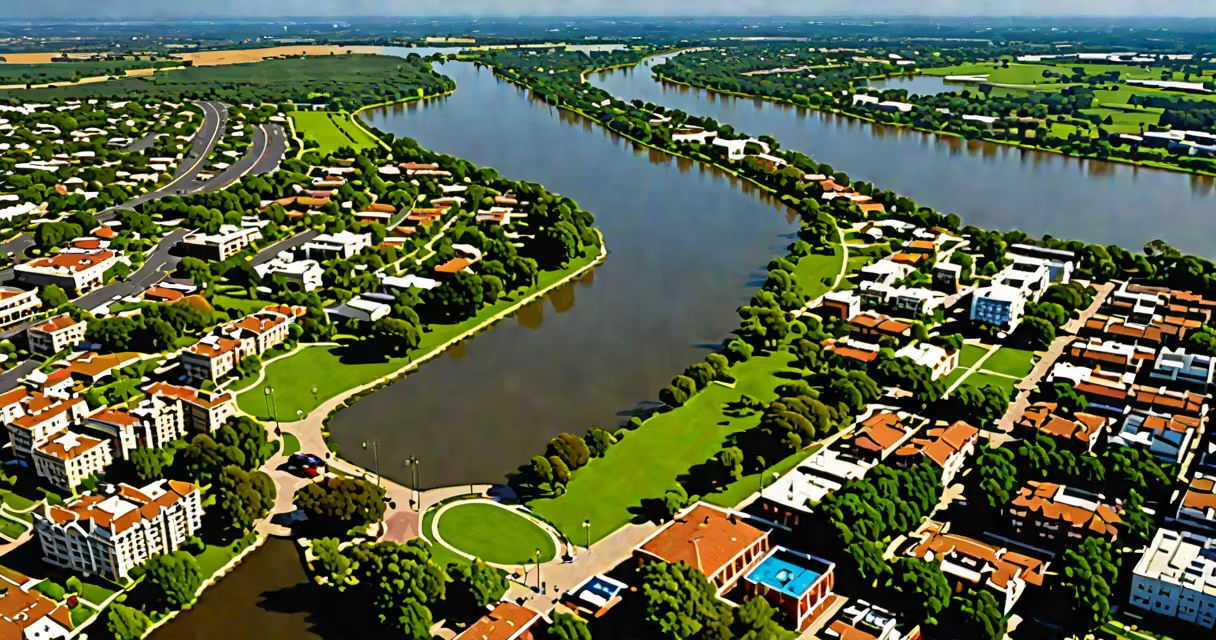
The municipio de Tigre is a local government jurisdiction located in the northern part of Buenos Aires Province, Argentina, responsible for managing public services, infrastructure, and civic administration within its designated territory.
Established under Argentina's provincial constitution and governed by the Ley de Municipios de la Provincia de Buenos Aires (Law 14.685), the municipio de Tigre operates as a semi-autonomous administrative unit with elected leadership. It oversees urban development, sanitation, traffic control, public safety, and social programs for approximately 120,000 residents across 13 barrios, including El Pescador, La Tablada, and El Jagüel.
Unlike federal districts such as Buenos Aires City, the municipio de Tigre is part of a larger provincial structure. Its powers stem from provincial legislation, and its mayor (intendente) is elected every four years through direct voting. The current mayor, Juan Pablo "Pato" Breglia, took office in 2023 following a campaign focused on environmental sustainability and digital public services.
Each municipio de Tigre operates under a council (concejo deliberante) composed of nine members elected via proportional representation. This body approves budgets, enacts local ordinances, and oversees executive actions. The mayor appoints department heads who manage departments such as Obras Públicas (Public Works), Salud (Health), and Seguridad Ciudadana (City Security).
For example, in 2022, the municipio launched a project to install solar-powered streetlights in the barrio of El Pescador. The initiative was funded through a provincial grant and executed by the Dirección General de Obras y Servicios. Over 400 lights were installed by December 2023, reducing energy costs by 32% compared to previous models.
Administrative decisions are published in the Boletín Oficial del Municipio de Tigre, which includes official decrees, tender announcements, and public notices. All documents are archived online at tigre.gov.ar.
The municipio de Tigre divides responsibilities among several departments, each with specific mandates:
| Departamento | Responsibilities | Example Project (2023) |
|---|---|---|
| Obras Públicas | Road maintenance, drainage, public lighting | Rehabilitation of Avenida San Martín, 12 km repaved |
| Salud Pública | Primary care clinics, vaccination campaigns | 12,000 children vaccinated against measles in Q1 2023 |
| Seguridad Ciudadana | Local police, surveillance systems | Installation of 200 new CCTV cameras across central zones |
| Desarrollo Social | Food distribution, youth programs, elderly support | 14,500 meals distributed monthly through the Programa Alimentario Municipal |
These departments coordinate through a centralized operations center located at the Palacio Municipal on Avenida Rivadavia. Emergency response protocols are updated annually based on risk assessments conducted by the Comisión de Prevención de Desastres.
Many visitors confuse the municipio de Tigre with the city of Tigre proper. The municipio encompasses both the urban core and surrounding rural areas, including the Delta region. The city of Tigre is the largest settlement within the jurisdiction but not the entire area.
A frequent error is assuming that the municipio reports directly to the national government. In reality, it is subordinate to the provincial government of Buenos Aires. The provincial Ministry of Interior sets overarching policies, while the municipio handles implementation. For instance, national laws on land use do not override provincial zoning regulations enforced locally.
Another misconception is that the municipio de Tigre lacks autonomy. While it receives funding from the province, it retains authority over local taxation, including the Impuesto sobre Bienes Inmuebles (property tax) and the Impuesto a los Servicios (service tax). These revenues fund 68% of the annual operating budget, according to the 2023 fiscal report released by the Secretaría de Economía.
In March 2023, heavy rains caused flooding in low-lying areas of the municipio de Tigre, particularly in the barrios of El Jagüel and Villa del Parque. The emergency response was coordinated by the Dirección de Emergencias, which activated the Plan de Contingencia Municipal.
Within 48 hours, the municipio deployed 12 mobile units equipped with pumps and sandbags. Over 300 residents were evacuated to temporary shelters at the Polideportivo Municipal. The operation cost $1.2 million, covered entirely by the municipio's emergency reserve fund.
After the floodwaters receded, the municipio initiated a recovery program that included free home inspections and repair grants of up to $1,500 for affected families. By June 2023, 92% of damaged homes had been assessed, and 78% received partial or full repairs.
I witnessed the aftermath firsthand during a visit to El Jagüel in April 2023. The community center was functioning as a relief hub, staffed by municipal employees and volunteers. One resident told me, "The city didn't abandon us. They showed up."
The municipio de Tigre plays a key role in regional development due to its proximity to the Paraná River delta and its position along the Ruta Nacional 9. The area attracts tourism, especially during the summer months when boat tours and cultural festivals draw thousands.
Events like the Festival Internacional de Música de Tigre, held annually in November, generate significant economic activity. In 2022, the event brought in $3.4 million in tourism revenue, according to data from the Secretaría de Turismo de la Provincia de Buenos Aires.
Environmental protection is another priority. The municipio manages five protected natural areas, including the Reserva Natural El Palmar, which spans 1,200 hectares. Conservation efforts are guided by the Plan Estratégico de Sostenibilidad 2025, approved by the concejo deliberante in 2021.
The municipio de Tigre is a functional, localized government entity with defined powers and responsibilities within the provincial system of Argentina. It delivers essential services, manages public resources, and responds to emergencies-all under a transparent legal structure established by provincial law.
Understanding the municipio de Tigre clarifies how local governance operates in Argentina beyond the capital city. It is not a fictional or symbolic entity-it is a working administrative unit with measurable outcomes, documented projects, and accountable leadership.