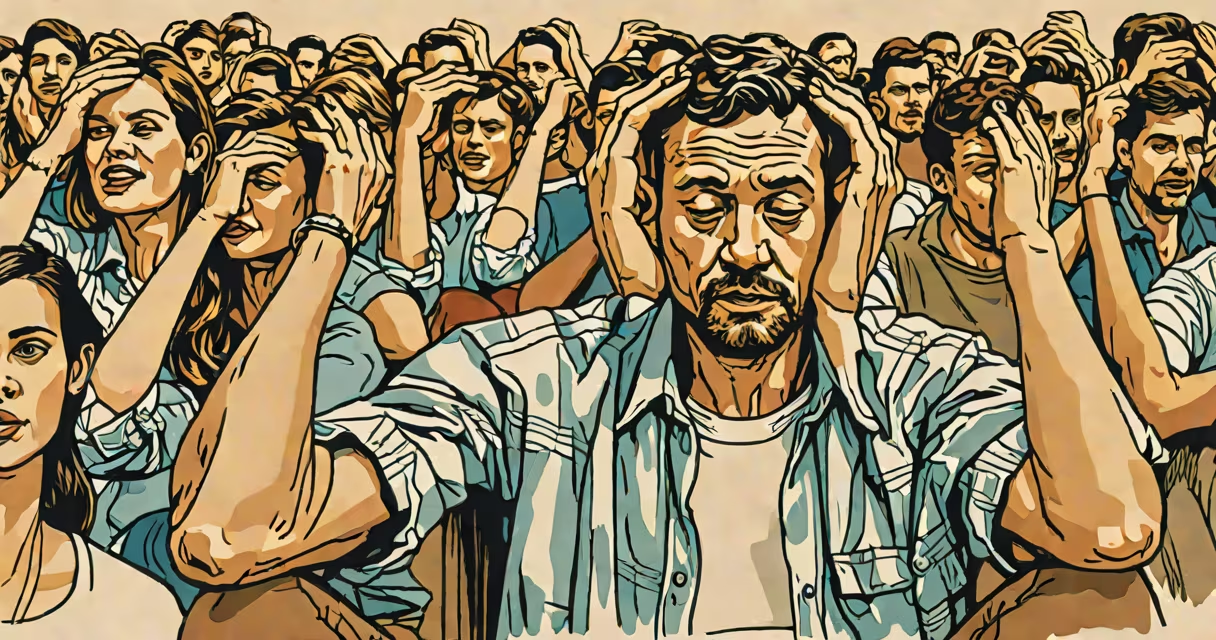
Feeling overstimulated occurs when your nervous system receives more sensory, emotional, or cognitive input than it can process effectively. This triggers a state of heightened arousal, leading to mental fatigue, irritability, and difficulty focusing. It's not a personality flaw-it's a biological response to excessive stimuli.
Overstimulation happens when your brain and body are flooded with signals from the environment-sounds, lights, conversations, screen time, or even internal thoughts. The result isn't just distraction; it's a measurable shift in neurological function. According to the National Institute of Mental Health, prolonged overstimulation can activate the sympathetic nervous system, increasing cortisol and adrenaline levels, which contribute to anxiety and burnout.
Common signs include sudden fatigue, emotional outbursts, avoidance of social settings, or feeling "spaced out" during routine tasks. These aren't signs of weakness-they're signals your system needs rest. Ignoring them consistently may lead to chronic stress and reduced resilience.
Your nervous system processes information through two main branches: the sympathetic (fight-or-flight) and parasympathetic (rest-and-digest). When overstimulated, the sympathetic system dominates. This shifts blood flow away from digestion and higher thinking toward muscles and reflexes-evolutionarily useful in danger, but harmful when triggered by everyday inputs.
Neurologically, overstimulation involves excessive activation of the amygdala-the brain's threat detector-and reduced activity in the prefrontal cortex, responsible for decision-making and emotional regulation. A 2021 study published in *Frontiers in Human Neuroscience* found that individuals with high trait anxiety showed greater amygdala reactivity to visual and auditory stimuli compared to controls, even in low-stress environments.
Physiologically, overstimulation can cause muscle tension, headaches, rapid heartbeat, and digestive issues. These symptoms often mimic other conditions, leading people to seek medical care for fatigue or migraines when the root cause is environmental overload.
Overstimulation isn't one-size-fits-all. Different people react strongly to different inputs based on neurotype, past trauma, or current mental load. Common forms include:
| Type | Primary Triggers | Typical Symptoms |
|---|---|---|
| Sensory | Loud noises, bright lights, crowded spaces, strong smells | Headaches, eye strain, shutting down, covering ears |
| Cognitive | Constant multitasking, information overload, decision fatigue | Mental fog, forgetfulness, inability to start tasks |
| Emotional | High-conflict conversations, news cycles, social media drama | Irritability, crying spells, emotional numbness |
For example, someone with autism spectrum traits may find fluorescent lighting in an office building physically painful. A student juggling classes, part-time work, and family responsibilities may hit cognitive overload after 90 minutes of focused studying. An adult processing grief might feel emotionally overstimulated by a casual comment about "moving on."
A key insight often missed: overstimulation doesn't require intense stimuli. A quiet room with a ticking clock, a single notification sound, or a brief argument can trigger a cascade in sensitive individuals. The threshold varies widely between people and even within the same person across days.
Overstimulation is frequently mistaken for laziness, lack of discipline, or attention deficit disorder. But it's not about motivation-it's about capacity. You can be highly driven and still feel overwhelmed by a single email chain or a five-minute phone call.
Another error is equating overstimulation with being "high-energy." Hyperactivity and overstimulation are distinct. One is a state of excess output; the other is a state of failed regulation. A child who runs around constantly may be overstimulated, but their behavior is not the cause-it's a symptom of dysregulation.
Overstimulation isn't always negative. Some people report creative bursts or heightened awareness during mild overstimulation. But sustained or severe states impair functioning. The American Psychological Association notes that while mild sensory stimulation can improve performance, exceeding individual thresholds leads to performance decline.
Consider Maya, a 28-year-old graphic designer working remotely. She starts her day with a 7 AM video meeting (sound and motion), checks Slack (notifications every 90 seconds), opens a design file with 12 layers, then gets a message from her partner asking about weekend plans. By 10:30 AM, she feels tense, can't concentrate, and snaps at her cat.
Her nervous system has been bombarded with visual, auditory, and emotional inputs. Her brain is in overdrive trying to manage multiple streams. She's not lazy-she's overloaded. Her body is signaling: "Pause. Reset."
When she steps outside for 10 minutes without devices, closes her eyes, and focuses on breathing, her heart rate drops. After 15 minutes, she returns to work with clearer focus. This is not a fix-it's a recovery strategy.
Recognition is the first step. Labeling the sensation as "I'm overstimulated" reduces shame and activates coping mechanisms. Research from the University of California, San Diego shows that naming emotional states improves emotional regulation and reduces cortisol spikes.
Immediate strategies include:
Long-term, build routines that protect your bandwidth. Schedule deep work blocks, limit screen time before bed, and set communication boundaries. For example, one client reduced overstimulation episodes by 60% after implementing a "no emails after 7 PM" rule and using noise-canceling headphones during focus hours.
As someone who's spent years managing sensory sensitivity, I've learned that overstimulation isn't something to eliminate-it's something to understand. My most productive days come not from pushing harder, but from protecting my mental space.
Understanding what it means to feel overstimulated helps you respond with care instead of judgment. It's not a failure-it's a signal. Your body is telling you something about your environment, your habits, and your limits. Listen. Adjust. Reclaim control.