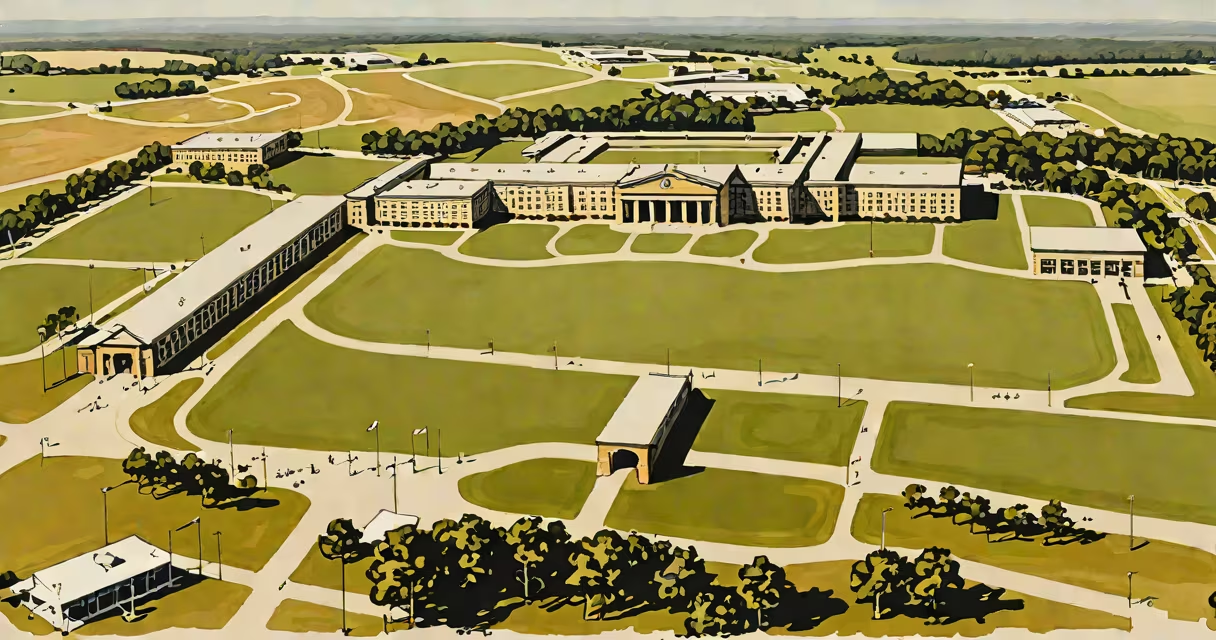
Fort Benning is a U.S. Army installation in Columbus, Georgia, serving as the primary training center for infantry and special operations forces. It hosts the U.S. Army Infantry School, the U.S. Army Ranger School, and the John F. Kennedy Special Warfare Center and School.
Established in 1918, Fort Benning was named after Confederate General Henry L. Benning. The base covers over 100,000 acres and supports thousands of active-duty personnel, reservists, and civilian employees annually. Its mission centers on preparing soldiers for combat through rigorous physical, tactical, and leadership training.
The base is home to the U.S. Army's most demanding programs. Soldiers who complete the 61-day Ranger Assessment Program at Fort Benning earn the right to wear the Ranger Tab. The Infantry School trains new officers and enlisted soldiers in small-unit tactics, weapons systems, and battlefield decision-making. Over 10,000 soldiers attend these programs each year.
Training at Fort Benning follows a structured progression. New recruits enter the Basic Combat Training program, then advance to Advanced Individual Training based on their military occupational specialty. Infantry soldiers undergo additional instruction in marksmanship, urban warfare, and survival skills.
Physical fitness is central to the curriculum. Soldiers must pass the Army Physical Fitness Test (APFT) every six months, scoring at least 60 points in each event: push-ups, sit-ups, and a two-mile run. Those who fail must retake the test within 30 days or face administrative action.
Combat simulations take place in the 14,000-acre Maneuver Area, where units conduct live-fire exercises, night operations, and simulated enemy engagements. These scenarios replicate conditions in Iraq, Afghanistan, and other conflict zones. Units train under stress to improve decision-making under fire.
Fort Benning hosts several elite military institutions:
| Program | Duration | Eligibility | Outcome |
|---|---|---|---|
| Infantry Officer Course | 16 weeks | Second lieutenants | Commissioned officer qualification |
| Ranger School | 61 days | Active-duty soldiers, select reservists | Ranger Tab, eligibility for special operations |
| Basic Airborne Course | 21 days | Any branch service member | Parachute qualification, airborne status |
Each program enforces strict standards. For example, Ranger School requires students to complete 12 miles of forced marches with full packs, often in rain or extreme heat. Failure rates exceed 50% due to physical exhaustion, mental fatigue, or inability to meet team objectives.
One non-obvious fact: Fort Benning does not have a permanent garrison. Most soldiers assigned there are in transit-either attending training or rotating through duty. This reduces housing demands and keeps infrastructure focused on training rather than family support.
People often confuse Fort Benning with West Point or Fort Bragg. West Point is the U.S. Military Academy, where cadets earn bachelor's degrees and commissions. Fort Bragg, in North Carolina, is the home of the 82nd Airborne Division and U.S. Army Special Forces. Fort Benning specializes in ground combat training, not officer education or airborne operations.
Another misconception is that Fort Benning is solely for infantry. While infantry training dominates, the base also hosts the U.S. Army's Joint Readiness Training Center, which prepares units for deployment in complex environments. These units include engineers, medics, and logistics specialists trained alongside combat arms.
Some assume the base is inactive during peacetime. In reality, Fort Benning runs continuous training cycles. During fiscal year 2023, over 12,000 soldiers completed courses at the Infantry School. The base also hosted joint exercises with NATO allies and partner nations, including annual drills with Georgian and Polish forces.
I observed a Ranger School selection phase during a visit in 2022. Candidates were dropped into the dense forests of the Chattahoochee National Forest with minimal supplies. They had to go through using maps and compasses, avoid simulated enemy patrols, and reach designated check points under time pressure. One soldier failed after collapsing from dehydration but was rescued by a medical team. His performance was reviewed, and he was dismissed from the course.
This scenario reflects actual combat conditions. In 2019, a Fort Benning graduate deployed to Afghanistan led a patrol that successfully extracted civilians during a Taliban ambush. He credited his ability to make split-second decisions to the stress inoculation training received at Fort Benning.
Fort Benning remains central to U.S. Army readiness. According to the U.S. Department of Defense, 78% of infantry officers commissioned between 2015 and 2023 completed training at Fort Benning. The base contributes to national defense by producing soldiers capable of operating in high-threat environments.
Its location in Georgia offers logistical advantages. The base lies near major transportation routes, enabling rapid deployment to Europe, Africa, and the Middle East. It also benefits from a mild climate, allowing year-round outdoor training.
For those seeking military service, Fort Benning represents a rite of passage. It is not just a facility-it is a proving ground. The challenges faced there shape soldiers' identities and prepare them for the realities of war.
Understanding what is Fort Benning reveals its role beyond a geographic name. It is a living institution where doctrine meets action, and where the U.S. Army builds its frontline strength.