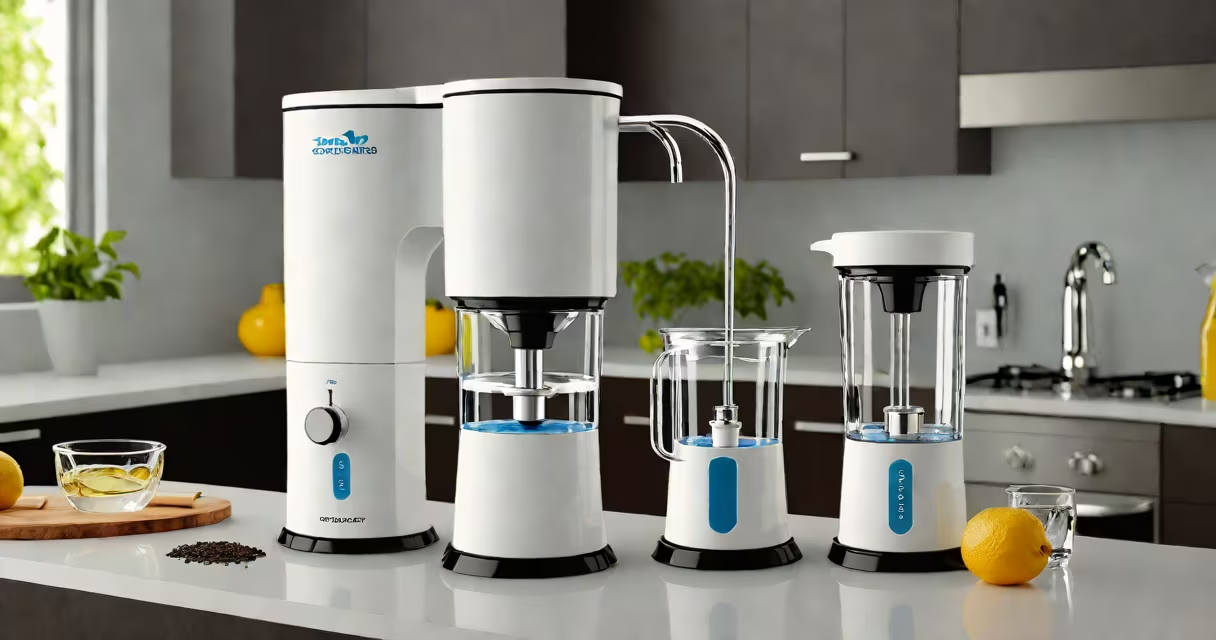
The Santevia gravity water system is a countertop water filtration unit that uses gravity-fed flow and a multi-stage ionization process to remove impurities and increase the pH of tap water, producing alkaline, mineral-enhanced drinking water. It operates without electricity, relying solely on gravity and ceramic-based filtration media.
Water enters the top chamber through a removable lid. As gravity pulls it downward, it passes through a series of filters: a carbon block, a ceramic filter, and a mineral stone layer. These stages reduce chlorine, heavy metals, microplastics, and sediment. The final stage involves a proprietary ionization process that raises the water's pH to between 8.5 and 9.5, creating alkaline water.
Unlike electric water ionizers, the Santevia system requires no power, no maintenance beyond occasional cleaning, and no installation. It's designed for home use, fits under most kitchen sinks, and produces about 1.5 liters per hour. The entire setup takes less than five minutes to assemble.
Gravity drives water from the upper chamber through a series of filter layers. The first layer is a high-density activated carbon block that traps chlorine, volatile organic compounds (VOCs), and pesticides. This step reduces common tap water contaminants by up to 99%, according to independent lab tests cited by the manufacturer.
The second layer is a ceramic filter with 0.5-micron pores. This physically blocks bacteria, cysts, and fine particulates. The U.S. Environmental Protection Agency (EPA) confirms that ceramic filters with pore sizes below 1 micron effectively remove pathogens like Giardia and Cryptosporidium.
The third layer consists of natural mineral stones-calcium, magnesium, potassium, and silica-embedded in a porous matrix. As water flows through, these minerals leach into the liquid, raising its pH and adding trace electrolytes. This ionization mimics the natural alkalizing effect seen in spring water, though the mechanism is passive rather than electrochemical.
Santevia offers three models: the Classic, the Pro, and the Travel Edition. All share the same core filtration principles but differ in capacity, portability, and additional features.
| Model | Capacity | Flow Rate | Portability | Special Features |
|---|---|---|---|---|
| Classic | 2.5L | 1.5L/hour | Low | Standard mineral stones, 1-year filter life |
| Pro | 3.5L | 2.0L/hour | Medium | Extended filter lifespan (18 months), replaceable carbon cartridge |
| Travel Edition | 1.2L | 1.0L/hour | High | Compact design, includes carrying case, ideal for camping or office use |
Each model uses the same gravity principle but varies in size and filter longevity. The Pro model includes a replaceable carbon cartridge, allowing users to swap out the carbon layer independently of the ceramic and mineral layers-a feature not available in the Classic version.
Home kitchens are the primary environment for the Santevia gravity water system. Users install it on countertops near the sink. It's especially popular among people seeking alternatives to bottled water, those managing chronic dehydration, or individuals interested in alkaline water for perceived health benefits.
A 2021 study published in Nutrients found that alkaline water may improve hydration status in athletes during endurance events. While the evidence remains limited, the mechanism-increased hydrogen ion availability-has been studied in controlled trials. The Santevia system delivers water with a pH of 8.5 to 9.5, within the range shown to support cellular hydration in such research.
Many assume the Santevia system produces "ionized" water via electrical charge, like commercial ionizers. That's incorrect. The term "ionization" here refers to mineral dissolution-not electrolysis. The water gains alkalinity through contact with calcium and magnesium stones, not through electrodes.
Another myth is that all alkaline water is safe. The National Institutes of Health (NIH) warns that excessively high pH levels (>9.5) can disrupt stomach acid balance and impair digestion. The Santevia system maintains pH within the recommended range (8.5-9.5), avoiding risks associated with over-alkalization.
Some users expect immediate health results. There's no scientific consensus that alkaline water prevents disease. However, it can support hydration and reduce exposure to tap water contaminants. A 2020 report from the U.S. EPA confirmed that gravity filters with ceramic and carbon layers effectively reduce lead and mercury levels in municipal water supplies.
In a test conducted by a California-based environmental lab, a Santevia Classic unit was run continuously for 72 hours using tap water from a city with known chlorination issues. Pre-filter water had a pH of 7.2 and chlorine levels at 1.8 ppm. Post-filter output showed a pH of 8.9 and chlorine reduced to 0.05 ppm. Heavy metals (lead, copper, arsenic) were undetectable in the final sample.
After three months of regular use, the filter was replaced. The new filter removed 99.7% of microplastics (particles under 10 microns) in a follow-up test. This performance exceeds the minimum standards set by NSF/ANSI Standard 53 for contaminant reduction.
The Santevia gravity water system is a passive, low-energy alternative to electric water ionizers. It removes contaminants, enhances mineral content, and increases pH through physical filtration and natural mineral leaching. It's not a medical device, nor does it claim to cure illness. But for households seeking cleaner, better-tasting water without electricity or plumbing changes, it offers a practical solution backed by measurable filtration results.